Short-Term Rentals (1-3 Months) in Vietnam: Market...
A comprehensive guide for expats on navigating the short-term rental market in Vietnam, covering legal registration, pricing in HCMC, and how to avoid common scams.
Entering the Vietnamese rental market for a stay of just one to three months can feel like a completely different world compared to signing a standard one-year lease. Whether you are a digital nomad testing the waters in Ho Chi Minh City, a project-based professional, or simply need a temporary home while searching for a long-term villa, the short-term market has its own set of rules, prices, and pitfalls.
In this guide, we break down the reality of short-term stays in 2026, from the legalities of police registration to the granular pricing of District 1 and Thao Dien.
1. Serviced Apartments vs. Condominiums: The Big Choice
Answer-first: Key overview and essential advice regarding Serviced Apartments vs. Condominiums: The Big Choice.
Digital Nomad Monthly Booking Strategies
Digital nomads staying in Vietnam for 1 to 3 months can secure substantial discounts (15–30% below published nightly Airbnb rates) by negotiating monthly stays directly with building landlords or serviced apartment operators. When arranging medium-term bookings, request a written agreement specifying a fixed utility deposit escrow (typically $100–$200) rather than standard 2-month security deposits.
Always require a live Wi-Fi speed test result (minimum 100 Mbps download / upload) before sending any holding funds, and verify whether the building management fee is included in the monthly rent. Many nomad-friendly serviced apartments also offer discounted monthly passes to co-working spaces like The Hive, Toong, or CirCO.
Answer-first: The first thing to understand is that not all properties are legally or practically suited for short-term stays.
The first thing to understand is that not all properties are legally or practically suited for short-term stays.
Serviced Apartments (CHDV)
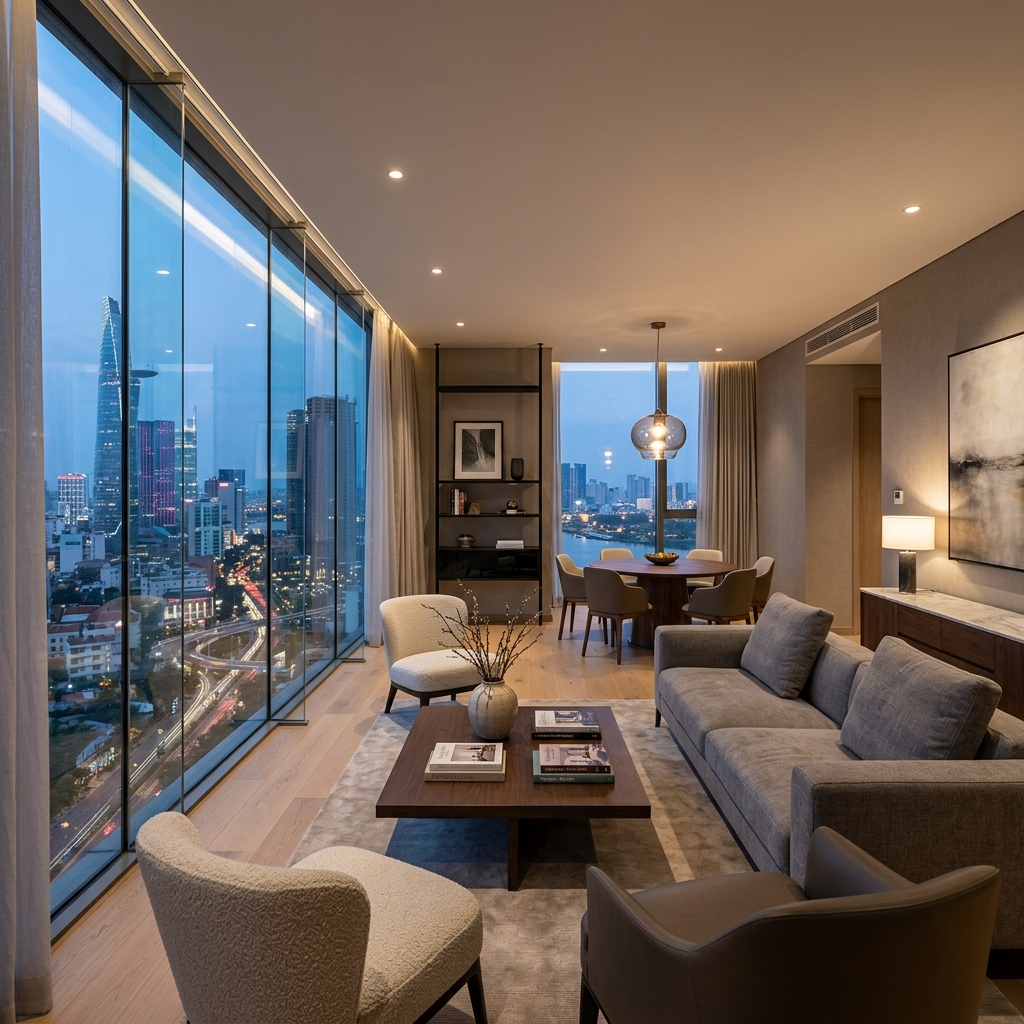
This is the “gold standard” for 1-3 month stays. A Serviced Apartment (Căn hộ dịch vụ) is essentially a cross between a hotel and an apartment.
- Pros: Full legal compliance (they are licensed to host foreigners short-term), included cleaning, laundry, and often electricity/water in the price.
- Cons: Higher monthly rates than standard condos.
- Best for: Professionals who want a “plug and play” experience without worrying about utility bills or registration.
Condominiums (Chung cư)
Renting a unit in a high-rise like Vinhomes Central Park or Masteri Thao Dien for only two months is often much harder.
- The Issue: Most individual landlords in these buildings prefer 12-month contracts. Furthermore, many buildings have strict management boards that make short-term registration difficult or technically “illegal” under certain residential zoning laws.
- Best for: Those who find a flexible landlord on Airbnb or through a specialized agent.
When viewing an apartment, always try to visit twice: once during the day to check natural light, and once at 8 PM to check for neighborhood noise and karaoke volume.

2. Market Pricing in Ho Chi Minh City (May 2026)
Answer-first: Prices have stabilized in 2026, but the “short-term premium” remains at about 20-30% above long-term rates.
Prices have stabilized in 2026, but the “short-term premium” remains at about 20-30% above long-term rates.
| Area | Studio (Short-term) | 1-Bedroom (Short-term) | Vibe |
|---|---|---|---|
| District 1 (Center) | 12M - 18M VND | 20M - 28M VND | Urban, fast-paced, walkable. |
| District 3 | 10M - 16M VND | 18M - 25M VND | Leafy streets, colonial charm, quiet. |
| Thao Dien (D2) | 8M - 15M VND | 15M - 22M VND | Expat hub, cafes, riverside. |
| Binh Thanh | 7M - 12M VND | 12M - 18M VND | Near center, local feel, good value. |
Note: Prices usually include high-speed Wi-Fi and water, but electricity is often charged separately at 4,000 - 4,500 VND/kWh.
3. The Legal Pillar: Temporary Residence Registration
Answer-first: One of the most common “gray areas” in Vietnam is the police registration (đăng ký tạm trú). Every foreigner staying in Vietnam must be registered with the local authorities.
One of the most common “gray areas” in Vietnam is the police registration (đăng ký tạm trú). Every foreigner staying in Vietnam must be registered with the local authorities.
In 2026, this process has moved entirely online. Landlords must use the official Ministry of Public Security portal at tbltkbtt.bocongan.gov.vn.
Why this matters for YOU:
- Visa Compliance: If you need to renew your visa or apply for a TRC, the authorities will check your registration history.
- Safety: If your landlord refuses to register you, it often means they are evading taxes or do not have the proper license to rent to foreigners. This is a massive “Red Flag.”
4. Security Deposits: How Much and How to Protect Them?
Answer-first: For a 1-3 month stay, the standard deposit is one month’s rent.
For a 1-3 month stay, the standard deposit is one month’s rent.
Protection Checklist:
- Contract Language: Ensure your contract is bilingual (English/Vietnamese). If there is a dispute, the Vietnamese version usually takes precedence in court, so having a trusted local friend or agent review it is vital.
- The “Pink Book” Check: Before handing over cash, ask to see a copy of the “Pink Book” (Giấy chứng nhận). This confirms the person you are paying is actually the owner or has the legal right to lease the property.
- Inventory List: Take photos and videos of the apartment on the day you move in. Send these to the landlord via Zalo or Email immediately so there is a time-stamped record of the condition.
5. Common Scams in the Short-Term Market
Answer-first: The high turnover of short-term rentals makes them a playground for scammers, especially on Facebook Groups.
The high turnover of short-term rentals makes them a playground for scammers, especially on Facebook Groups.
- The “Holding Deposit” Scam: An agent asks for 2-5 million VND to “hold” a beautiful studio while you are still abroad. They vanish as soon as the money hits their account. Rule: Never pay before a physical viewing.
- Bait and Switch: You see a stunning $700 apartment online. When you arrive, the agent says it was just taken but they have a “similar” (and much worse) unit for the same price.
- Electricity Inflation: Some landlords charge 5,000+ VND/kWh or “forget” to show you the meter reading at the start of the month. Always take a photo of the meter on Day 1.
6. Recommended Short-Term Stays
Answer-first: If you are looking for verified quality, we recommend starting your search with professional serviced apartment blocks.
If you are looking for verified quality, we recommend starting your search with professional serviced apartment blocks.
- District 3: Serviced Apartment Leman — High-end amenities in a central but quiet location.
- District 2: Check out the smaller boutique CHDV buildings near Xuan Thuy street for the best mix of community and convenience.
7. Final Advice for 2026
Answer-first: Renting short-term is about flexibility. Don’t be afraid to pay a slightly higher price for a “Serviced Apartment” if it means avoiding the headaches of registration and utility management. In the long run, the peace of mind is worth the extra $100 a month.
Renting short-term is about flexibility. Don’t be afraid to pay a slightly higher price for a “Serviced Apartment” if it means avoiding the headaches of registration and utility management. In the long run, the peace of mind is worth the extra $100 a month.
FAQ: Short-Term Rentals in Vietnam
Answer: Short-term rentals (1–3 months) in Saigon cost $450–$900/month through Airbnbs or serviced apartment operators, typically eliminating 2-month deposit demands.
Do I need a special visa to rent an apartment for 2 months?
Technically, any valid visa (E-visa, Tourist, or Business) allows you to rent a licensed property. However, the property must be licensed to host foreigners.
Can I negotiate the price for a 3-month stay?
Yes. Most landlords price their units based on a 1-year average. If you are staying for 3 months, you can often negotiate a 5-10% discount compared to the “daily” or “weekly” rate found on platforms like Airbnb.
Is Airbnb legal in Vietnam?
Yes, it is legal, but hosts are still required to register guests with the local police. Always message the host beforehand to confirm they will handle the online registration.
What happens if I want to leave early?
In most short-term contracts, leaving early means forfeiting your security deposit. If you are unsure of your dates, look for properties with “Flexible” cancellation policies.
Should I pay in USD or VND?
Legally, all transactions within Vietnam must be in VND. While some landlords may quote in USD, the actual payment and contract should be in VND to be legally enforceable.
For single digital nomads seeking community and lower deposits, review our Guide to Co-Living Spaces in Ho Chi Minh City.
Additional Expat Living & Rental Guidance for 2026
When navigating the rental market in Ho Chi Minh City and Hanoi, foreign tenants must pay close attention to lease agreement fine print, landlord communication protocols, and building management rules. Before committing to a multi-year residential lease, always conduct an independent walkthrough during both daytime and evening hours to evaluate street noise levels, elevator wait times, and cell signal strength inside interior bedrooms.
5-Point Mandatory Lease Negotiation & Safety Checklist:
- Security Deposit Refund Clause: Require written confirmation that the 2-month security deposit will be refunded in full within 14 business days post move-out via bank wire transfer, minus verified utility balance deductions.
- Police Residence Registration (Tạm Trú): Ensure the landlord guarantees online temporary residence registration within 24 hours of receiving your passport copy and signed lease contract.
- Air Conditioner Maintenance: Mandate that the landlord conducts a comprehensive AC deep cleaning and gas top-up prior to move-in, with semi-annual servicing costs split fairly or covered by the property owner.
- Utility Tariff Transparency: Confirm that electricity is billed directly via official EVN tariffs (or building management at state rates) rather than arbitrary landlord markups exceeding 3,500 VND per kWh.
- Force Majeure & Early Termination: Insert a 30-day notice diplomatic exit clause in the event of corporate job relocation, visa non-renewal, or documented force majeure events.
Related Reading & Listings
Answer-first: Curated list of related property reviews, neighborhood guides, and market reports.